
Table of Contents
You’re sitting down at a poker table for the first time. Chips are stacked in front of you. Someone says “raise.” Someone else folds. The dealer slides cards across the felt. You nod, glance at your hole cards — and quietly wonder if you’re doing any of this correctly.
That feeling is universal. Every player at that table has been there.
This guide walks you through how to play poker from zero — specifically Texas Hold’em, the format you’ll encounter in every poker club, casino, and online room worldwide. By the end, you won’t just know the rules. You’ll know how to think at the table.
Why “Properly” Matters: The Gap Between Knowing and Playing
Most people who’ve “played poker” haven’t actually learned to play poker. They’ve tapped all-in on a mobile app where chips reload for free. Or they’ve sat at a home game copying moves without understanding what drives them.
Rules alone are maybe 20% of the picture. The real game is built on structure — knowing why each action happens, not just what to do when it’s your turn.
There’s a hard difference between someone who’s heard of the flop and someone who understands what the flop changes about their decision. This guide closes that gap. When the poker basics land properly, the rest of the game opens up fast.
The Setup: What You Need to Know Before the First Card Is Dealt
The Table, the Chips, and the Deck
Poker is played with a standard 52-card deck. No jokers. Two to nine players typically sit at a table, though most club games run with six to eight.
Chips are the currency of the game, not decorative props. Each color represents a specific denomination — at any poker club, you exchange cash for chips before sitting down. Treat every chip as having real monetary value, because it does.
The moment you start thinking “it’s just chips,” you’ve already made an expensive mistake.
The Dealer Button — Your Most Important Landmark
That round disc marked “D” on the felt? That’s the dealer button. It’s the single most important object in the game, and it’s not there to mark who shuffles the deck.
The button moves one seat clockwise after every hand. The two players immediately to the left of the button must post forced bets before any cards are dealt. The first player posts the small blind (half the table minimum), the next posts the big blind (the full minimum bet). These aren’t penalties — they’re the mechanism that creates action and gives everyone something to fight for in every hand.
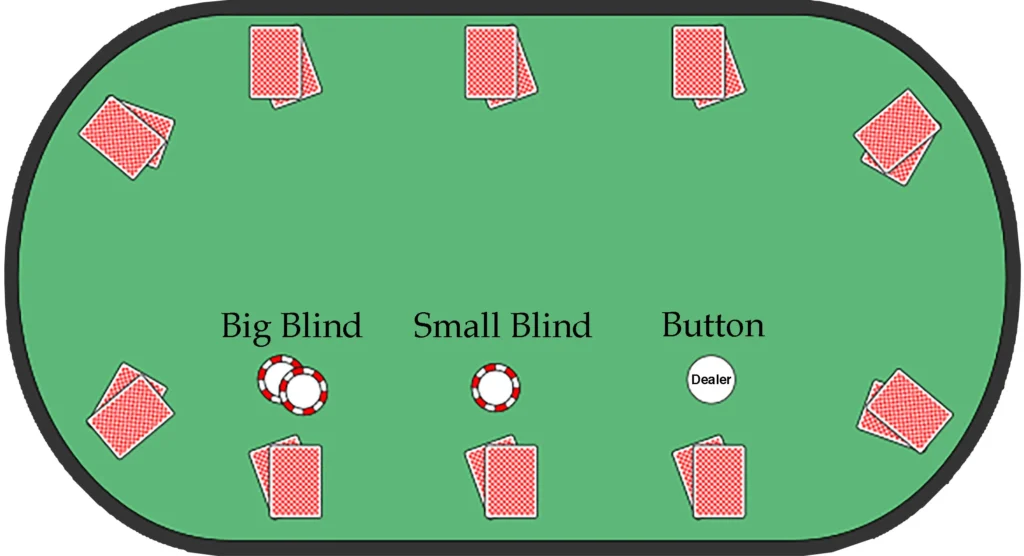
💡 Think of the button as a “you act last” pass. The player holding it sees every other player’s decision before making their own.
This clockwise rotation is how Texas Hold’em determines the order of everything — who bets first, who speaks last, who has the informational advantage. Understand the button and the structure of the whole game becomes readable.
The Goal of Poker (It’s Not What Most Beginners Think)
Here’s the thing that surprises nearly everyone learning to play poker for the first time: you do not need the best hand to win.
There are exactly two ways to take a pot in Texas Hold’em:
- Show the best five-card combination at the showdown — after all betting is done.
- Be the last player remaining — meaning everyone else has folded their cards before a showdown even happens.
That second path is where bluffing lives. A well-timed bet can represent a strong hand so convincingly that every opponent folds — and you collect the pot without ever showing what you were actually holding.
⚠️ This is why poker is fundamentally a game about information, not just cards. Two players can hold identical hands and one still makes more money — because of how they play the situation.
Both win conditions matter. Learning to recognize which one is achievable in any given hand is what separates instinct from skill.
Poker Hand Rankings: Know These Before Anything Else
Memorize this table before your first session. Everything — every bet, every fold, every bluff — happens in the context of these ten hand rankings.
The 10 Hands, Ranked from Best to Worst
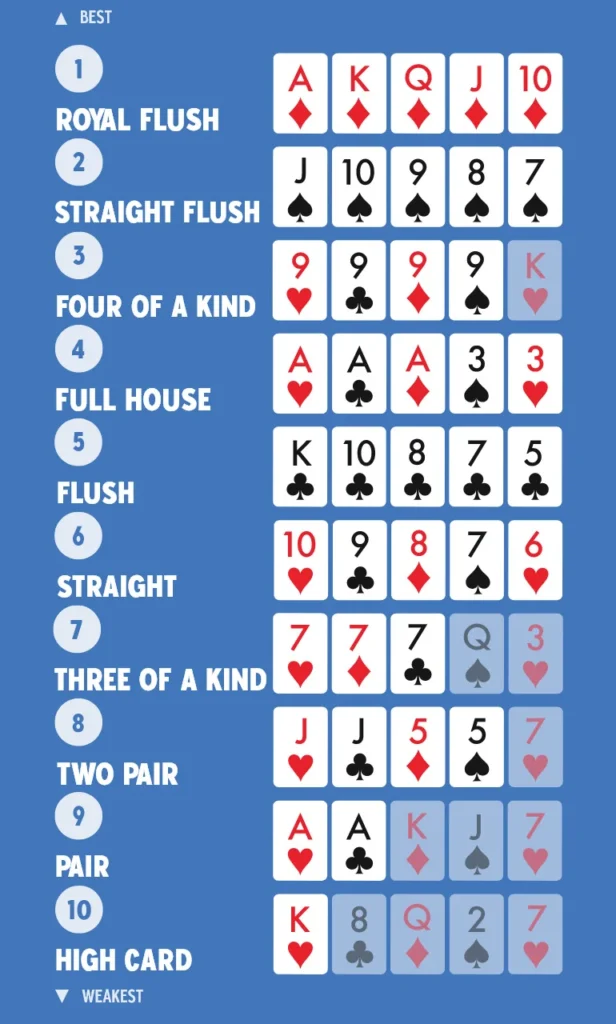
📸 Screenshot this. It’s your cheat sheet for the first few sessions.
One important edge case worth knowing now: when two players have the same combination, the pot goes to whoever has the higher supporting cards — called the kicker. Both players make a pair of Aces? The player with the stronger next-highest card wins. Two identical hands across all five cards means the pot splits.
In Texas Hold’em, you build the best possible five-card hand using any combination of your 2 private cards and the 5 community cards on the table. You’re always working with 7 cards total and choosing the strongest five.
How a Hand of Texas Hold’em Works — Step by Step
This is the heart of how to play poker. Walk through it once and the second hand will feel completely natural.
Step 1 — Post the Blinds
Before a single card moves, the two players left of the dealer button post their forced bets: small blind and big blind. The amounts depend on the stakes of the game.
These bets seed the pot and create immediate incentive to play. No blinds — no action.
Step 2 — Receive Your Hole Cards (Pre-Flop Begins)
Every player receives two cards dealt face-down. These are your hole cards — private cards only you can see.
Now the first betting round begins. It starts with the player directly left of the big blind and moves clockwise. This stage is called the pre-flop. You look at your two cards and make the first real decision of the hand: is this worth playing?
Step 3 — Your 4 Options at the Table
Every time the action reaches you, you choose one of these:
FOLD   → Discard your cards. You're out of this hand. No further loss beyond bets already made.
CALL   → Match the current bet to stay in.
RAISE  → Increase the bet. Every remaining player must call your raise or fold.
CHECK  → Pass the action to the next player — only available when no one has bet yet in the current round.
There’s a fifth option that reshapes a hand entirely: all-in — putting every chip you have in front of you into the pot. When a player goes all-in, they can no longer be forced out of the hand by further bets; any additional chips from other players create a side pot that only active players contest.
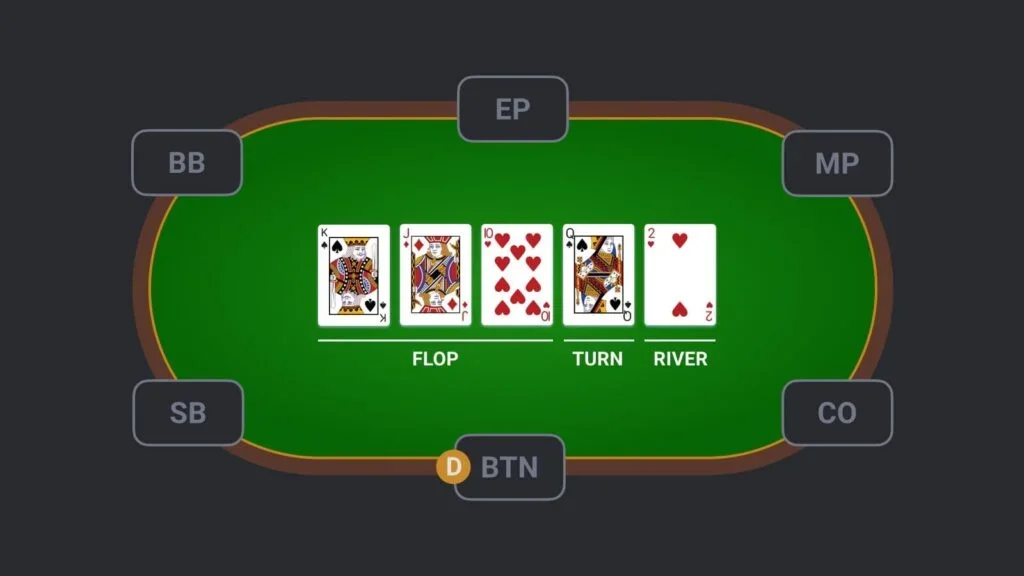
Step 4 — The Flop (3 Community Cards Appear)
Pre-flop betting ends. The dealer places three community cards face-up in the center of the table.
This is the flop. Every player uses these shared cards together with their hole cards to build a hand. Suddenly you can see whether your two private cards have connected with the board — or missed entirely.
The second betting round begins, starting from the first active player left of the dealer button.
Step 5 — The Turn (4th Card)
A fourth community card arrives face-up. This is the turn.
Bets often escalate here. The pot is bigger, the field is narrower, and players with strong draws are running the math on what they need from the final card.
Another round of betting follows the same structure: check, bet, call, raise, or fold.
Step 6 — The River (5th and Final Card)
The fifth and last community card lands. The river.
No more cards coming. This is the final betting round. Decisions made here are permanent — and the most expensive errors happen when players misread their equity at this exact moment.
Step 7 — The Showdown
If two or more players remain after river betting, it’s showdown time. Cards go face-up on the table.
The player with the best five-card hand wins the entire pot. If every other player folded before reaching the showdown, the last remaining player takes the pot without showing their hand.
The flow of every Texas Hold’em hand:
Pre-Flop → [Betting] → Flop → [Betting] → Turn → [Betting] → River → [Betting] → Showdown
Table Position — The Invisible Advantage No Beginner Knows About
Here’s the concept that most poker guides skip entirely when writing for beginners. It’s also one of the highest-leverage ideas in the game.
Position means: when in the betting order do you act?
At a full table, players cycle through early position (acting first, just after the blinds), middle position, and late position (acting last, near or on the button). The dealer button is the most powerful seat in Texas Hold’em — you see the entire table’s decisions before committing to anything yourself.
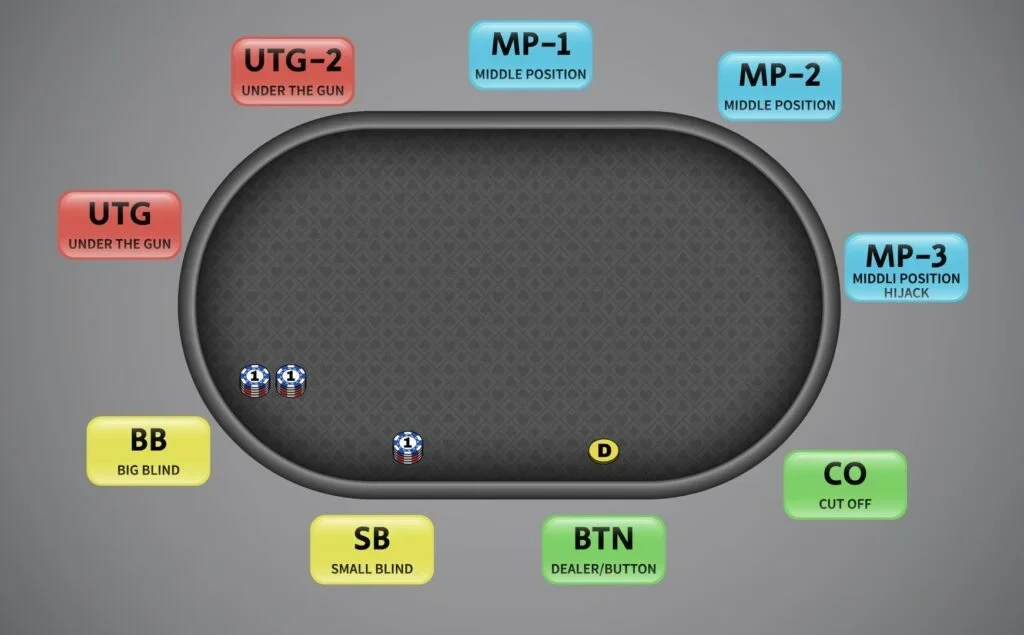
💡 Being last to act is like reading everyone’s poker face before making your own move. That information has real value.
The practical consequence: in early position, only open strong hands. You’ll be acting blind relative to most of the table for the rest of the hand. In late position — especially on the button — you have the full picture and can play a wider range profitably.
This is the first piece of poker strategy that transitions someone from knowing the rules to actually playing poker. Every single professional player thinks in terms of position on every street.
Starting Hands — The Habit That Separates Winners from Everyone Else
Want a simple edge over most recreational players? Play fewer hands.
This feels counterintuitive. But it’s foundational. Professional poker players fold the vast majority of their starting hands — sometimes 70-80% of hands dealt to them. In a mobile app, where chips are infinite and there’s no cost to seeing a flop, playing every hand makes sense. At a real table, every call has a price.
Here’s a practical starting framework for Texas Hold’em:
PLAY (Almost Always): AA, KK, QQ, AK suited, AK offsuit — these are your premium hands. Raise them pre-flop. Don’t fold them pre-flop.
CONSIDER (Depends on Position): JJ, TT, AQ suited, KQ suited, suited connectors — playable from late position or the button, more cautiously from early position.
FOLD (Usually): Random low cards, mismatched rags, 7-2 offsuit (the infamously worst hand in poker). They feel like possibilities. They’re not.
⚠️ Playing every hand is the single most expensive mistake beginners make. Fold more. Win more.
Build the discipline of folding early and you’ll already be ahead of half the table before the cards hit the felt.
From App to Real Money — Bankroll Basics for First-Time Players
Here’s a mindset shift nobody covers enough for players making the jump from mobile poker to a real poker club.
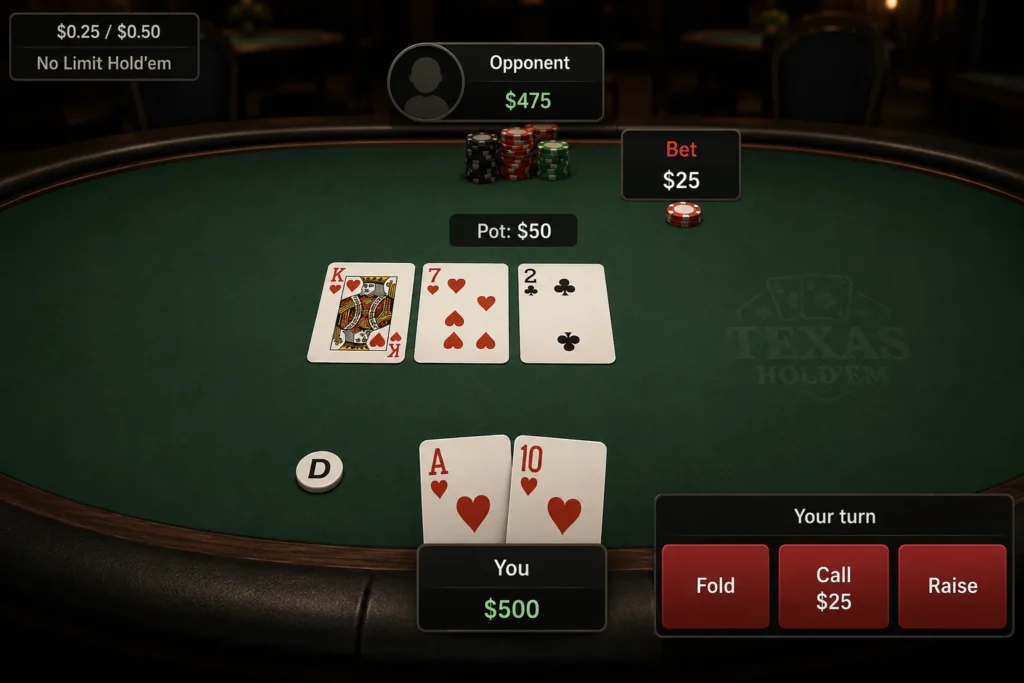
In an app, going all-in costs nothing — chips reload with a tap. That habit, brought to a live table, will bleed your stack inside twenty minutes. When each chip has actual monetary value, your decision-making recalibrates completely. The math matters. The fold matters. The position matters.
This recalibration is the real game, and it’s worth embracing.
Simple rule for your first time: sit down with an amount you can comfortably lose without it affecting you. That’s not pessimism. That’s sound bankroll management.
Start at micro stakes — games with the minimum available buy-in. Online this means $0.01/$0.02 blinds; at a live poker club, the lowest available limit game. These tables exist precisely so new players can develop without catastrophic variance.
The principle behind bankroll management: never put more than 5% of your total poker budget on a single table. If your poker bankroll is $100, buy in for $5–10. Staying in the game long enough to improve is the whole point.
At our club, dedicated beginner tables run with low limits specifically so your first sessions are about learning the game — not surviving it.
Poker Table Etiquette — How Not to Be That Guy
The social layer of poker is real. And it matters more than most guides acknowledge — because the fear of doing something embarrassing at a live table is one of the main things that stops people from ever sitting down.
Here’s everything you need to not be that person.
Do this:
- ✅ Announce your action out loud: “Raise” / “Call” / “Fold” — spoken declarations prevent disputes
- ✅ Act in turn — react only when the action has actually reached you, not before
- ✅ Place chips forward neatly in front of your stack; don’t toss them into the pot (that’s called splashing the pot and it disrupts the count)
- ✅ Stay attentive — when it’s your turn, be ready
Don’t do this:
- ❌ Show your cards to any player during an active hand, even casually
- ❌ Make a string bet — if you’re raising, say so first or push all your raise chips in a single motion. Moving chips in multiple trips without declaring is illegal at most tables
- ❌ Slow roll — if you have the winning hand, show it promptly. Pausing for dramatic effect insults your opponent and kills table atmosphere
- ❌ Comment on the hand or advise anyone while the hand is in progress, even if you’ve already folded
Follow these guidelines and you’ll fit in at any live table, beginner game or otherwise.
Ready to Play? Here’s Your Next Step
Let’s take stock of what you’ve just absorbed.
You understand the setup — the deck, the chips, the dealer button, the blinds. You know there are two ways to win a hand, not one. The poker hand rankings are clear, from Royal Flush down to High Card. You’ve walked through all four betting streets of a Texas Hold’em hand, step by step. You know position exists and why it matters. You have a starting hand framework. You understand bankroll management basics. You know how to behave at a live table without second-guessing yourself.
That’s more than most people bring to their first seat.
What remains is practice. Real hands. Real chips. Real decisions with consequences. The concepts land differently when there’s an actual pot in the middle — and that’s a good thing.
Join our poker club — we have dedicated beginner tables where you can put everything you just learned into practice. No pressure. Real people.
FAQ (Frequently Asked Questions)
Is poker a game of luck or skill?
Both — but skill wins over time. Short-term variance means any player can win a session or even a weekend. But across thousands of hands, players who understand position, starting hand selection, pot odds, and betting strategy consistently outperform those who rely on fortune alone. The poker hand rankings are fixed; what separates players is how intelligently they navigate every decision around them.
How long does a typical poker hand take?
In a live poker game, a single hand typically runs 2–5 minutes from shuffle to showdown. In online formats with shot clocks, individual decisions happen in under 60 seconds. A full session — cash game or tournament — runs anywhere from one hour to 4+ hours depending on the format and how the table is playing.
What is the best poker variant for complete beginners?
Texas Hold’em. No contest. It’s the most widely played poker format on the planet, has the deepest library of learning resources, and is the standard game at virtually every poker club and online room. Learn Texas Hold’em properly first — every other variant (Omaha, Stud, mixed games) becomes easier once the Hold’em framework is solid.
What is the difference between a cash game and a tournament?
In a cash game, chips have direct monetary value, you can join or leave at any time, and you can rebuy freely. In a tournament, every player pays a fixed buy-in for the same starting chip stack and plays until one person holds everything. For beginners, cash games with minimum buy-ins tend to be more forgiving — you control how much you bring to the table and you’re not locked into a four-hour commitment.
Can I learn poker in one day?
You can learn the poker rules in under an hour — this guide covers exactly that. But poker has real depth: position reads, bet sizing, bankroll discipline, reading opponents, adjusting mid-session. Those take months to internalize. The upside: everything covered here is enough to sit down at a real table, make sound decisions, and have a great time from your very first hand.
Read More:
X-Poker vs PPPoker in 2026: Which App to Choose?
X-Poker Omaha Guide 2026: From Hold’em to PLO Adaptation
X-Poker Crashing? How to Fix App Crashes Fast
What Is an Agent in X-Poker, PPPoker? Roles, Responsibilities, and How It Actually Works
Poker Outs and Odds 2026: What They Are, How to Count Them, and How to Use Them at the Table